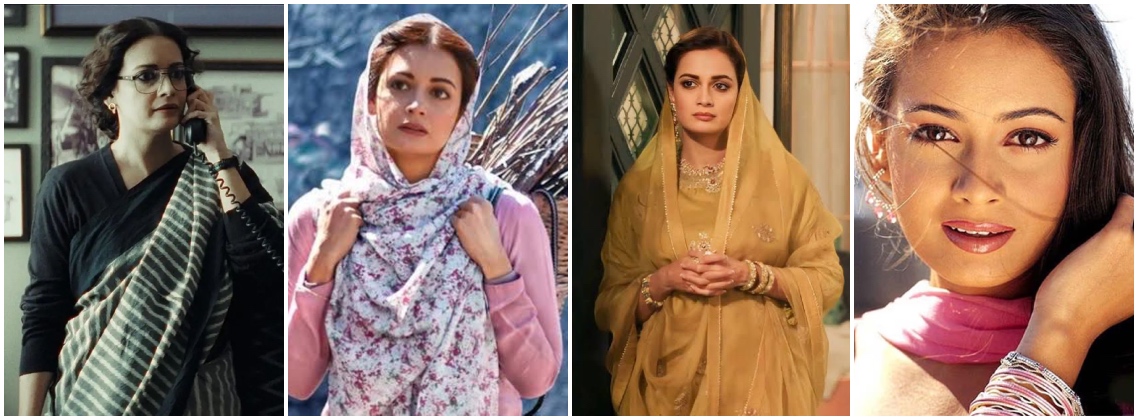
From Rehnaa Hai Terre Dil Mein to IC 814: The Kandahar Hijack, Dia Mirza’s career unfolds not as a conventional Bollywood ascent, but as a study in restraint, intention, and emotional intelligence. As she completes 25 years in the film industry, what stands out is not reinvention through spectacle, but evolution through choice.
From the innocence of Reena Malhotra to the authority of Shalini Chandra, Dia’s filmography traces a quiet but powerful arc—one shaped by empathy, moral clarity, and an increasingly deliberate commitment to stories where women reclaim agency, dignity, and self-worth. Especially over the last decade, her work has reflected a deepening engagement with complexity, positioning her as one of Hindi cinema’s most consistently purposeful performers. A journey shaped by intention:
Rehnaa Hai Terre Dil Mein (2001) – Reena Malhotra
At just 19, Dia’s debut gave Hindi cinema one of its most iconic romantic introductions. The rain-soaked entry, dancing with children, became shorthand for innocence and longing. As Reena, she embodied gentleness and idealism, setting the tone for a career rooted in sincerity rather than excess.
Parineeta (2005) – Gayatri
In this period romance, Dia brought grace and emotional restraint to Gayatri, a woman shaped by social hierarchies and quiet sacrifice. Her performance added texture and balance, holding its own alongside Vidya Balan and Saif Ali Khan.
Lage Raho Munna Bhai (2006) – Simran
As Simran, Dia lent warmth and sincerity to a film that blended humour with Gandhian philosophy. Her presence reinforced the film’s moral core without ever overpowering it.
Love Breakups Zindagi (2011): Dia Mirza stepped into the role of a producer in 2011 for the first time with Love Breakups Zindagi, a feel-good Bollywood film that continues to resonate for its warmth and relatability. In the film, Dia also essays the role of Naina Kapoor, a talented and fiercely independent photographer who believes that a stable, if emotionally unfulfilling, life is good enough. Thoughtful and self-aware, Naina navigates her fear of commitment and a long-term relationship with Dhruv, eventually realising that real contentment lies in choosing authentic happiness over comfortable compromise.
Sanju (2018) – Manyata Dutt
In one of Indian cinema’s biggest blockbusters, Dia brought dignity and restraint to Manyata Dutt. Eschewing theatrics, she grounded the role in emotional realism, offering a rare, empathetic glimpse into a woman navigating fame and fracture.
Kaafir (2019) – Kainaaz Akhtar
A defining moment in her career, Kaafir placed Dia at the narrative’s emotional centre. As Kainaaz, a woman imprisoned across borders by fate and politics, she delivered a performance of haunting vulnerability and resilience—arguably her finest to date.
Thappad (2020) – Shivani
As Shivani, Dia became the film’s quiet conscience—refusing to normalise violence and empowering another woman to choose dignity. Her strength lay in empathy, not confrontation.
Bheed (2023) – Geetanjali
Set against the pandemic, Dia’s Geetanjali steps out of privilege to confront uncomfortable truths. Her performance added emotional depth to the film’s socio-political urgency.
Made in Heaven Season 2 (2023) – Shehnaz
In one of her most layered roles, Shehnaz navigates polygamy, abuse, and silence. Dia revealed the character’s inner transformation with remarkable restraint, turning stillness into strength.
Dhak Dhak (2023) – Uzma
As Uzma, a repressed housewife and skilled mechanic from Old Delhi, Dia portrayed liberation as a lived, earned journey. The film added one of the most empowering characters to her body of work.
IC 814: The Kandahar Hijack (2024) – Shalini Chandra
Calm, incisive, and empathetic, Shalini Chandra marked Dia’s seamless command in high-stakes ensemble storytelling. The role reaffirmed her command over women in leadership—measured, credible, and quietly formidable.
Across 25 years, Dia Mirza has built a filmography that resists noise and spectacle, choosing instead depth, empathy, and moral courage. In doing so, she hasn’t just evolved as an actor—she has quietly redefined what longevity, purpose, and power can look like in Hindi cinema.